

Socrates, the classical Greek philosopher credited as a founder of Western philosophy, left no written works of his own; his teachings and famous sayings were recorded by his students, primarily Plato and Xenophon. Below is a curated collection of his most well-known quotes, explanations, and related insights.
Socrates’ Most Famous Quotes
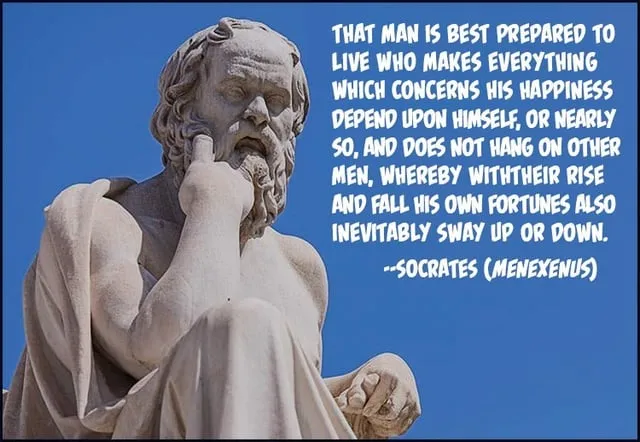
On Wisdom and Knowledge
- “The only true wisdom is in knowing you know nothing.”
- “The unexamined life is not worth living.”
(The sentiment is attributed to him through Plato’s accounts.) - “There is only one good, knowledge, and one evil, ignorance.”
- “Wisdom begins in wonder.”
- “I cannot teach anybody anything. I can only make them think.”
On Life and Virtue
- “Not life, but a good life, is to be chiefly valued.”
- “Virtue does not come from money, but from virtue comes money and all other good things to man, both to the individual and to the state.”
- “Let him that would move the world first move himself.”
- “We cannot live better than in seeking to become better.”
On Personal Conduct
- “Know thyself.”
- “Thou shouldst eat to live; not live to eat.”
- “Be slow to fall into friendship, but when you are in, continue firm and constant.”
Socrates’ Last Words
Reportedly spoken just before his death by hemlock poisoning:
“Crito, we owe a cock to Asclepius; please pay it and don’t forget it.”
(This offering to Asclepius—the god of healing—was traditionally made after recovery, suggesting Socrates viewed death as release from life’s ailments.)
What Are Three Famous Quotes by Socrates?
Three of his most widely cited statements are:
- “The only true wisdom is in knowing you know nothing.”
– Highlights his method of questioning assumptions and acknowledging the limits of human knowledge. - “The unexamined life is not worth living.”
– Emphasizes the importance of self-reflection and critical inquiry. - “Know thyself.”
– Although inscribed at Delphi, Socrates popularized the saying as a central philosophical principle.
Socrates’ Famous Quote: “I Know Nothing”
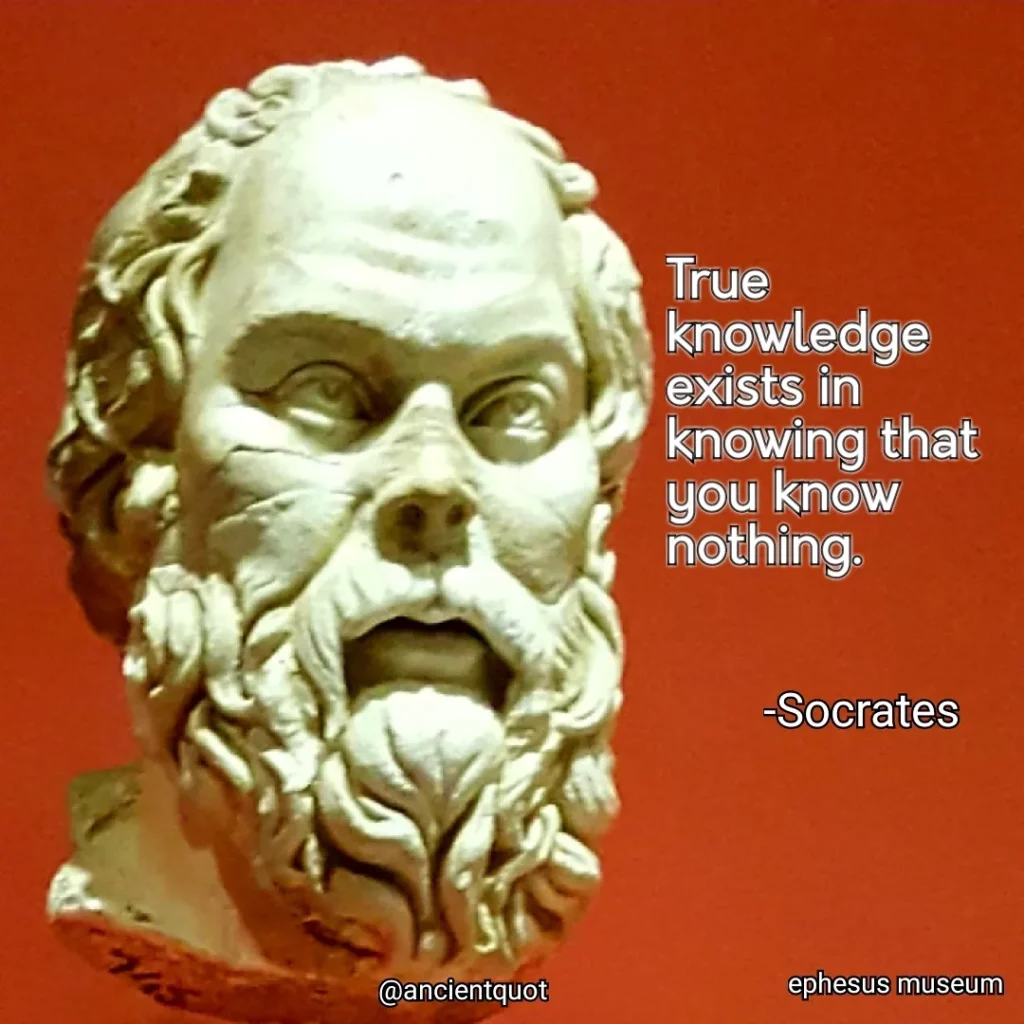
The famous statement often paraphrased as “I know that I know nothing” or “The only true wisdom is in knowing you know nothing” originates from Plato’s Apology (21d).
Socrates explains:
- The Oracle of Delphi proclaimed no one wiser than Socrates.
- Confused, Socrates questioned politicians, poets, and craftsmen.
- He discovered that many claimed knowledge they did not actually possess.
- His realization: He was “wise” only because he recognized his own ignorance.
This quote expresses intellectual humility and the commitment to lifelong learning—not total ignorance.
Socrates’ Quotes on Intelligence
Socrates often conflated the concepts of intelligence and wisdom with the pursuit of knowledge and the awareness of one’s own limitations. His quotes emphasize humility and a continuous quest for understanding rather than innate cleverness.
On the Nature of Intelligence and Learning
- “I know that I am intelligent, because I know that I know nothing.”
- Intelligent people learn from everything and everyone; average people from experience; those who believe they know everything are not intelligent.
- “We gain our first measure of intelligence when we first admit our own ignorance.”
- “I cannot teach anybody anything. I can only make them think.”
On the Mind and Discourse
- “Strong minds discuss ideas; average minds discuss events; weak minds discuss people.”
(Often linked to Socrates but more accurately associated with Eleanor Roosevelt.) - “To find yourself, think for yourself.”
- “Understanding a question is half an answer.”
On the Value of Knowledge
- Socrates believed knowledge is the only good and ignorance the only evil.
- “Education is the kindling of a flame, not the filling of a vessel.”
Quotes from Socrates, Plato, and Aristotle
Here are famous quotes attributed to three foundational figures of Western philosophy: Socrates, Plato, and Aristotle.
Socrates
- “The only true wisdom is in knowing you know nothing.”
- “The unexamined life is not worth living.”
- “There is only one good, knowledge, and one evil, ignorance.”
- “Know thyself.”
- “Not life, but a good life, is to be chiefly valued.”
Plato
- “Ignorance, the root and stem of all evil.”
- “Democracy… is a charming form of government, full of variety and disorder; and dispensing a sort of equality to equals and unequal alike.”
- “Justice in the life and conduct of the State is possible only as a outcome of justice in the minds and lives of individual citizens.”
- “Music is a moral law…”
- “Courage is knowing what not to fear.”
Aristotle
- “Man is by nature a political animal.”
- “We are what we repeatedly do. Excellence, then, is not an act, but a habit.”
- “The root of all education is bitter, but the fruit is sweet.”
- “It is the mark of an educated mind to be able to entertain a thought without accepting it.”
- “Happiness is the meaning and the purpose of life…”
Most Famous Quotes of Socrates
The most famous and defining quotes of Socrates, which capture the essence of his philosophy of self-examination and intellectual humility, are:
Cornerstones of His Philosophy
- “The only true wisdom is in knowing you know nothing.”
- “The unexamined life is not worth living.”
Other Well-Known Statements
- “Know thyself.”
- “There is only one good, knowledge, and one evil, ignorance.”
- “I cannot teach anybody anything. I can only make them think.”
Socrates’ Quotes on Knowledge
Socrates often equated knowledge with virtue, arguing that true understanding was the basis for a moral life. He emphasized intellectual humility and the pursuit of wisdom through self-awareness.
On the Nature of Knowledge
- “The only true wisdom is in knowing you know nothing.”
- “There is only one good, knowledge, and one evil, ignorance.”
- “I know that I am intelligent, because I know that I know nothing.”
- “We gain our first measure of intelligence when we first admit our own ignorance.”
On Teaching and Learning
- “I cannot teach anybody anything. I can only make them think.”
- “Wisdom begins in wonder.”
- “Education is the kindling of a flame, not the filling of a vessel.”
- “Understanding a question is half an answer.”
On the Value of Knowledge
- “Knowledge which is acquired under compulsion obtains no hold on the mind.”
- “An unexamined life is not worth living.”
Socrates’ Quotes on Education
Socrates believed that true education was a process of drawing knowledge out of the student’s mind through questioning and critical thinking, rather than merely pouring facts in.
- “Education is the kindling of a flame, not the filling of a vessel.”
- “Knowledge which is acquired under compulsion obtains no hold on the mind.”
- “I cannot teach anybody anything. I can only make them think.”
- “Wisdom begins in wonder.”
- “The understanding of a question is half the answer.”
- “He who is not a good servant will not be a good master.”
- “The unexamined life is not worth living.”
Plato Quotes
Plato, the Athenian philosopher and student of Socrates, left a rich legacy through his dialogues, which explore themes of justice, knowledge, reality, and love. Here are some of his most famous quotes:
On Knowledge and Wisdom
- Ignorance is the root of all evil.
- Knowledge gained under compulsion does not endure.
- The wise speak when they have something meaningful to say; fools speak to be heard.
- The more one learns, the more one realizes how much remains unknown.
- Thinking is the soul’s internal dialogue.
On Politics and Society
- Those who refuse to participate in politics risk being ruled by less capable individuals.
- Good people who ignore public affairs may end up governed by those with malicious intentions.
- Peace comes when philosophers rule or rulers practice philosophy.
- Democracy offers equality to all, regardless of merit.
- Upright citizens don’t need laws to behave well, while wrongdoers will always circumvent them.
On Life, Love, and Virtue
- Self-mastery is the greatest achievement.
- Love inspires everyone to become a poet.
- Desire, emotion, and knowledge motivate human behavior.
- Only the dead have seen the end of war.
- Children fear the dark; adults fear enlightenment.
- True wealth lies in being content with modesty.